

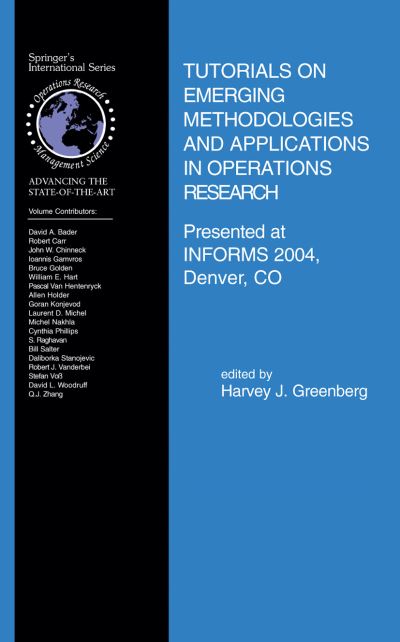
This volume reflects the theme of the INFORMS 2004 Meeting in Denver: Back to OR Roots. Emerging as a quantitative approach to problem-solving in World War II, our founders were physicists, mathematicians, and engineers who quickly found peace-time uses. It is fair to say that Operations Research (OR) was born in the same incubator as computer science, and it has spawned many new disciplines, such as systems engineering, health care management, and transportation science.
Although people from many disciplines routinely use OR methods, many scientific researchers, engineers, and others do not understand basic OR tools and how they can help them. Disciplines ranging from finance to bioengineering are the beneficiaries of what we do - we take an interdisciplinary approach to problem-solving. Our strengths are modeling, analysis, and algorithm design.
We provide a quanti- tive foundation for a broad spectrum of problems, from economics to medicine, from environmental control to sports, from e-commerce to computational - ometry. We are both producers and consumers because the mainstream of OR is in the interfaces. As part of this effort to recognize and extend OR roots in future probl- solving, we organized a set of tutorials designed for people who heard of the topic and want to decide whether to learn it.
The 90 minutes was spent addre- ing the questions: What is this about, in a nutshell? Why is it important? Where can I learn more?
In total, we had 14 tutorials, and eight of them are published here.
| ISBN: | 9780387228266 |
| Publication date: | 21st October 2004 |
| Author: | Institute for Operations Research and the Management Sciences, Harvey J Greenberg |
| Publisher: | Springer an imprint of Springer New York |
| Format: | Hardback |
| Pagination: | 342 pages |
| Series: | International Series in Operations Research & Management Science |
| Genres: |
Operational research Numerical analysis Management decision making Maths for computer scientists Computer-aided design (CAD) Discrete mathematics |
This volume reflects the theme of the INFORMS 2004 Meeting in Denver: Back to OR Roots. Emerging as a quantitative approach to problem-solving in World War II, our founders were physicists, mathematicians, and engineers who quickly found peace-time uses.
Tutorials on Emerging Methodologies and Applications in Operations Research features in the following genres: Operational research, Numerical analysis, Management decision making, Maths for computer scientists, Computer-aided design (CAD), Discrete mathematics
Paperback, Hardback. Not Available.
Tutorials on Emerging Methodologies and Applications in Operations Research was written by Institute for Operations Research and the Management Sciences, Harvey J Greenberg and published by Springer an imprint of Springer New York
Tutorials on Emerging Methodologies and Applications in Operations Research has 342 pages
Yes it is part of International Series in Operations Research & Management Science series